LOGO JAT

Al-Tijarah: Journal of Islamic Economics, Finance and Business

Al-Tijarah: Journal of Islamic Economics, Finance and Business (ISSN Online: 3109-1709) is an international, peer-reviewed, open-access journal published by the Department of Islamic Economics, Faculty of Islamic Economics and Business, Institut Miftahul Huda Al Azhar Kota Banjar, Indonesia. The journal publishes high-quality original research, review articles, conceptual papers, and case studies in the fields of Islamic economics, finance, business, and related interdisciplinary studies. It particularly welcomes research on Islamic economic development, Islamic finance, Islamic business management, Islamic social finance, halal economy, and public policy related to Islamic economic institutions.

Search Articles & Publications

lock_open Open Access
track_changes Aims and Scope
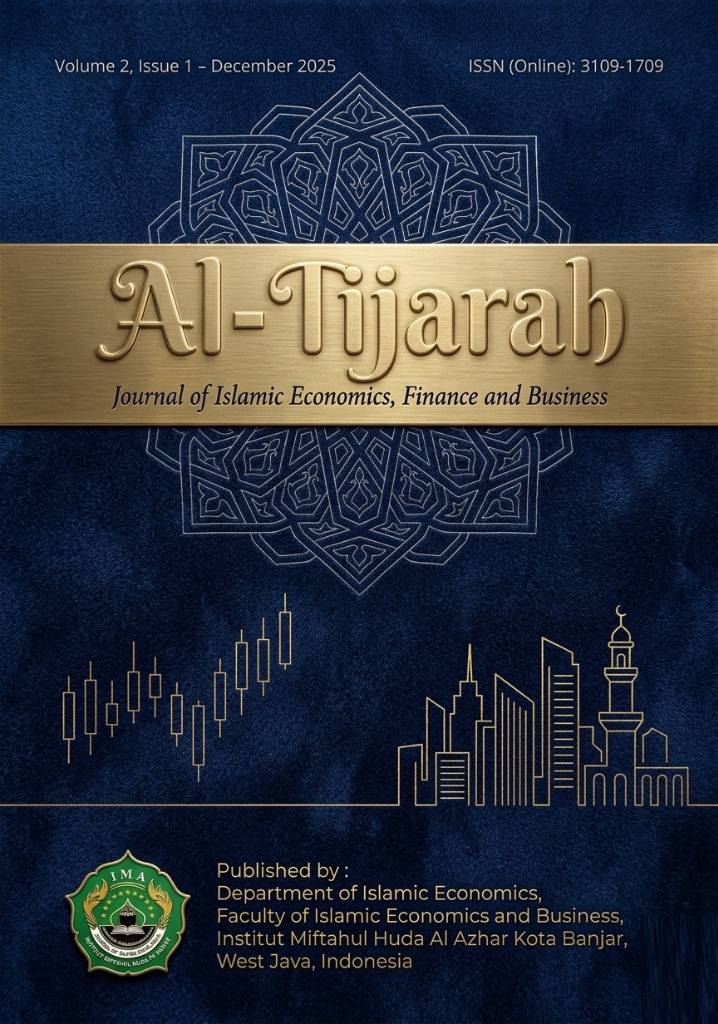
Cover Al-Tijarah
campaign Call for Papers

Al-Tijarah: Journal of Islamic Economics, Finance and Business

Vol. 2 No. 2 (2026): June– In Progress

event
Submission Deadline: 15 November 2026
publish
Publication Month: December 2026
language
Language: English
update
Publication Frequency: Biannual (June & December)
lock_open
Access: Open Access
rate_review
Peer Review: Double-Blind Peer Review

Explore Articles: Vol. 1 No. 2 (2025): June

View All arrow_forward
					View Vol. 1 No. 2 (2025): June

This peer-reviewed issue presents contemporary insights into Islamic economics and public policy, with contributions from researchers specializing in fiscal policy, halal tourism, and international Islamic finance. Articles explore the impact of taxation and inflation on Indonesia’s economic growth, propose ushuliyyah-based frameworks for waqf-led halal tourism in Southeast Asia, and analyze tax policy in the context of global economic volatility. The June 2025 edition highlights efforts to align national economic strategies with Islamic ethical principles, offering comparative perspectives between Indonesia and Malaysia.

Published: 2026-07-17

Artikel

  • Artikel lock_open

    The Impact of Tax Revenue and Inflation Rate on Economic Growth in Indonesia

    Zahrotul Lutfiah ID , Utry Setiyoningsih ID , Masuwd Mowafg Abrahem LY

    Introduction: This study explores the impact of tax revenue and inflation on economic growth in Indonesia during the period of national recovery following the COVID-19 pandemic. Tax revenue plays a fundamental role in supporting government spending and development programs, while inflation poses risks to economic stability and purchasing power.

    Methods: A multiple linear regression approach was used to examine the relationship between economic growth and the two variables—tax revenue and inflation. The data was collected from national statistical agencies and other relevant institutions.

    Results: The study found that tax revenue contributes positively to economic growth by enabling the government to invest in infrastructure, education, and public services. In contrast, inflation has a detrimental effect, as rising prices reduce household consumption and discourage investment.

    Discussion: These findings emphasize the need for a balanced fiscal and monetary approach. Strengthening tax collection systems while simultaneously implementing measures to keep inflation under control is crucial for fostering economic resilience and long-term growth.

    Conclusion: Policies that enhance tax efficiency and maintain price stability are essential for ensuring sustainable economic development in Indonesia.

    Novelty: This research offers a current perspective on the dual influence of fiscal and monetary variables on Indonesia’s economy during a critical post-pandemic period of adjustment and growth.

  • Artikel lock_open

    Reformulating Ushuliyyah Principles to Strengthen Waqf-Based Halal Tourism Industry in Indonesia and Malaysia

    Zuanda Zulkifli ID , Arwansyah bin Kirin MY

    Introduction: Waqf is a crucial Islamic economic instrument, yet its role in modern industries like halal tourism in Indonesia and Malaysia is still underdeveloped. This study aims to reformulate Ushuliyyah principles to strengthen waqf governance in the halal tourism sector.

    Methods: Using a qualitative normative approach and comparative analysis, this research examines legal texts, waqf regulations, and industry data from both countries. Discourse analysis is applied to identify strategies for reformulation.

    Results: The reformulated Ushuliyyah principles prioritize protecting public interest (maslahah) and preventing harm (mafsadah) in managing waqf assets for halal tourism. This alignment enhances waqf effectiveness and sustainability.

    Discussion: The findings indicate that waqf-based halal tourism can foster economic growth and social welfare when supported by a solid legal framework grounded in Ushuliyyah principles. Cross-border collaboration is vital to address regulatory and stakeholder challenges.

    Conclusion: Reformulating Ushuliyyah principles tailored to halal tourism waqf offers a practical framework for optimizing waqf contributions to Indonesia and Malaysia’s halal economy.

    Novelty: This study uniquely connects Ushuliyyah legal maxims with waqf development in halal tourism through a comparative approach.

  • Artikel lock_open

    Harnessing Tax Policy to Accelerate Islamic Economy as a Growth Engine in Developing Countries

    Emi Masruroh ID , Endah Silviana ID , Nurul Ilyana Muhad Adnan MY

    Introduction: Islamic economy holds significant potential to support economic growth in developing countries. However, limited fiscal incentives and unintegrated tax policies hinder its optimal contribution to national development.

    Methods: This study employs descriptive analysis using secondary data from the Financial Services Authority (OJK), global Islamic economy reports, and taxation policies in Indonesia and other developing nations. The objective is to assess the alignment between tax strategies and Islamic economic development.

    Results: Indonesia’s Islamic banking market share remains at 7.3%, with financing concentrated in trade and consumption. The VAT increase to 12% and the adoption of a digital tax administration system aim to boost revenue. However, insufficient tax incentives for halal SMEs and exporters constrain the sector’s global competitiveness.

    Discussion: Integrating Islamic finance with inclusive tax reform—such as tax exemptions for exporting halal SMEs, the development of Islamic green sukuk, and the digitalization of zakat and waqf—could strengthen economic resilience and sectoral productivity.

    Conclusion: Adaptive and transparent tax policy aligned with Islamic economic growth strategies is vital for achieving sustainable economic progress in developing nations.

    Novelty: This research highlights the strategic integration of taxation and Islamic economic development as a key driver of inclusive growth in the digital era.

  • Artikel lock_open

    Consumption Tax Policy Responses in Indonesia and Malaysia: An Islamic Economic Perspective on Global Uncertainty

    Nadia Djawas Dara ID , Hasanah Abd Khafidz MY

    Introduction: This study examines the impact of taxation policies on economic growth within the framework of Islamic economics in developing countries, focusing on Indonesia and Malaysia. It highlights the role of tax reforms and Islamic finance development amid digital transformation.

    Methods: A qualitative analysis was conducted using secondary data from government reports, academic articles, and policy documents. The study compares tax administration reforms and Islamic economic initiatives in both countries.

    Results: Indonesia’s tax reforms show mixed results with initial revenue contraction due to new system implementation but indicate recovery potential. The Islamic finance sector in Indonesia has room to grow but faces integration and digitalization challenges. Malaysia demonstrates more advanced integration of fiscal incentives and technology, supporting stronger Islamic economic growth.

    Discussion: Findings suggest tax policies must balance revenue needs and investment incentives while improving digital infrastructure and regulatory frameworks. Lessons from Malaysia can guide Indonesia to enhance Islamic economic contributions to growth.

    Conclusion: Strategic tax policy and Islamic economic development can drive inclusive growth in developing countries. Success depends on coherent policies, institutional support, and technology adoption.

    Novelty: The study uniquely links tax policy with Islamic economics in a comparative context, offering insights for emerging economies.

  • Artikel lock_open

    Sharia Economic Law Review on Minimum Work Tenure for Lecturer Certification at West Java PTKIs

    Ulummudin Ulummudin ID , Habibi Habibi ID , Andrey V. Kotyazhov RU

    Introduction: Lecturer Certification (Serdos) is a professional legitimacy mechanism governed by Government Regulation No. 37 of 2009 and Ministerial Regulation No. 44 of 2024, requiring at least two years of service and the academic rank of Assistant Expert as prerequisites. However, various deviations from these requirements have been identified at several Islamic Religious Higher Education Institutions (PTKI) in West Java.
    Methods: This study uses a qualitative descriptive approach by analyzing primary documents, relevant legal frameworks, and conducting interviews with lecturers at PTKI institutions who experienced inconsistencies in the certification process.

    Results: The findings indicate that some lecturers were certified despite not fulfilling the two-year tenure requirement or submitting their Workload Reports (BKD). These discrepancies suggest irregularities in administrative control and potential violations of the regulatory framework.

    Discussion: In the perspective of Sharia Economic Law, such practices contradict the principles of ‘adl (justice), amanah (trust), and maslahah (public benefit). Misallocation of certification funds undermines the integrity of public finance governance and erodes the ethical foundations of Islamic higher education.

    Conclusion: The study calls for a reassessment of Serdos policies, particularly regarding tenure requirements and monitoring mechanisms. It also emphasizes the importance of aligning implementation with Sharia-based ethical governance.

    Novelty: This research introduces a Sharia Economic Law perspective to evaluate Serdos implementation, and recommends affirmative policies prioritizing lecturers who hold doctoral degrees or academic ranks of Lektor, recognizing their academic merit without being bound strictly by tenure length.